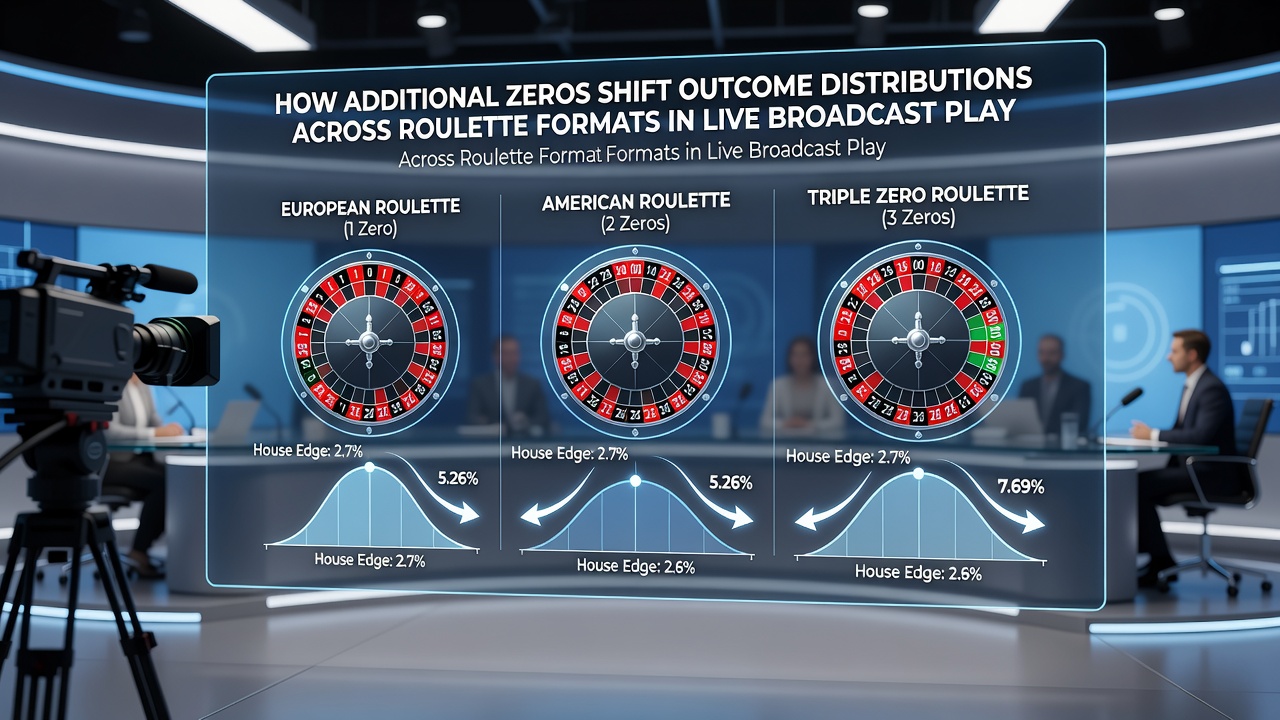
How Additional Zeros Shift Outcome Distributions Across Roulette Formats in Live Broadcast Play
Live broadcast roulette presents multiple wheel formats that differ primarily through the number of zero pockets on the wheel, and researchers have documented how each additional zero alters the underlying probability structure for every betting outcome. Standard European wheels contain 37 pockets with one zero while American wheels use 38 pockets that include both a zero and a double zero, creating measurable differences in the distribution of results across thousands of spins. Observers note that these structural variations affect not only the house edge but also the frequency patterns that emerge in real-time streamed sessions where physical wheels operate under continuous camera monitoring.
Wheel Configurations and Pocket Counts
European format wheels maintain 37 pockets consisting of numbers 1 through 36 plus a single zero, whereas American wheels expand to 38 pockets by adding the double zero, and some newer variants introduce a third zero to reach 39 pockets. Data from regulatory records shows that each extra zero increases the total number of non-numbered outcomes without changing the distribution of the numbered pockets themselves. Those who track live broadcast feeds observe that wheel manufacturers calibrate these configurations to precise physical tolerances, yet the added zeros shift the mathematical baseline for all subsequent probability calculations.
Studies of outcome sequences reveal that the probability of landing on a specific number remains 1 in 37 on European wheels but drops to 1 in 38 on American wheels and further to 1 in 39 on triple-zero variants. Because the zero pockets carry their own payout rules, the presence of multiple zeros concentrates more probability mass on house-favored results while diluting the frequency of straight-up number hits across long sessions.
Impact on Even-Money and Column Bets
Even-money bets on red or black encounter a clear redistribution when additional zeros enter the wheel. On a single-zero wheel the probability stands at 18 out of 37, yet that figure becomes 18 out of 38 once the double zero appears, and the same pattern repeats for high-low and odd-even wagers. Column and dozen bets follow identical shifts because they cover 12 numbers each, so the numerator stays fixed while the denominator grows with every zero added.
Live broadcast operators frequently switch between these formats within the same stream, and analysts have recorded how players encounter different expected frequencies depending on which wheel the studio activates. Figures from gaming oversight agencies indicate that the cumulative effect across hundreds of spins produces detectable deviations in payout ratios that align precisely with the theoretical adjustments.
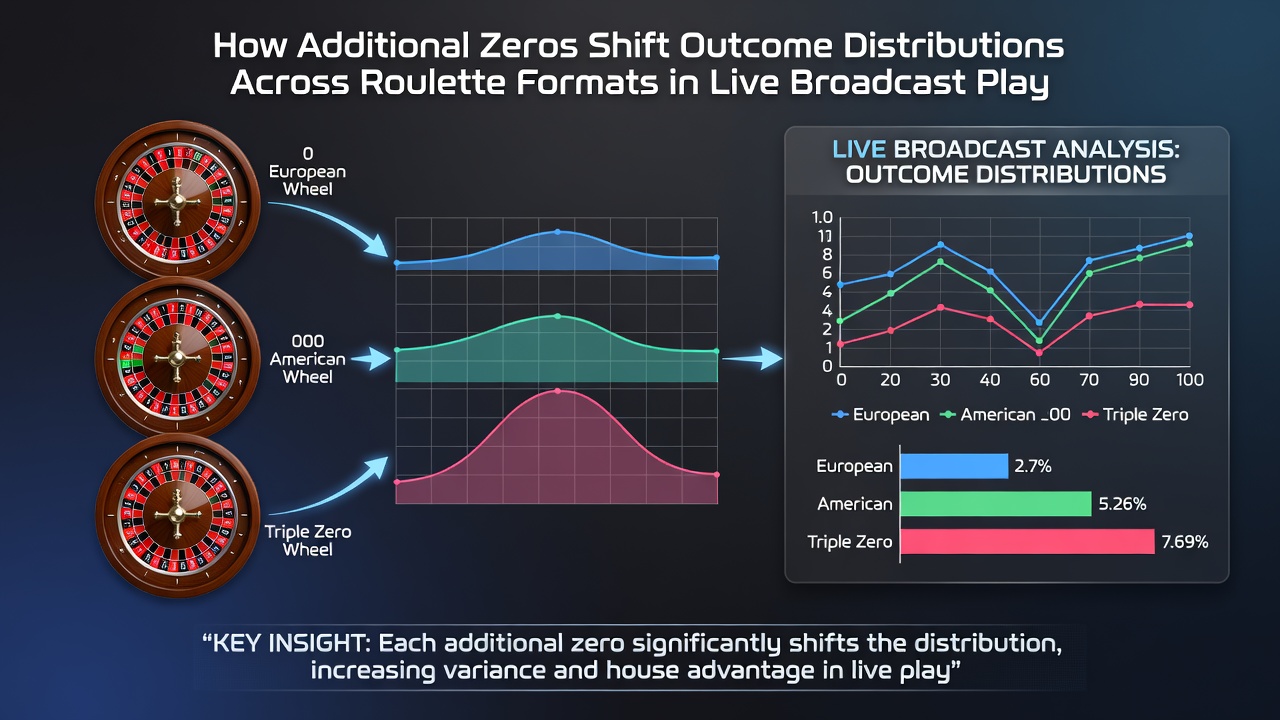
Statistical Distribution Changes in Extended Play
Researchers applying binomial models to roulette sequences demonstrate that the variance and expected value of returns adjust directly with pocket count. A single-zero wheel yields a house edge of 2.7 percent on most bets, while double-zero wheels raise that figure to 5.26 percent and triple-zero wheels push it higher still. These percentages translate into measurable differences in the long-run distribution of net outcomes, with the additional zeros increasing the proportion of spins that return nothing to the player.
Live broadcast data collected over thousands of spins confirms that the clustering patterns around zero outcomes become more pronounced as pocket numbers rise. Operators who maintain records for compliance purposes report that distribution tails extend further on multi-zero wheels, producing longer sequences without player wins on outside bets. Such patterns emerge consistently across independent streams, indicating that the effect stems from wheel geometry rather than random fluctuation.
Regulatory Data and Cross-Regional Comparisons
Reports compiled by the Nevada Gaming Control Board document payout ratios across licensed live dealer operations that employ both single-zero and double-zero wheels, revealing consistent alignment with theoretical predictions. Similar statistics gathered by Canadian provincial regulators show parallel shifts when facilities introduce American-style wheels into their live broadcast offerings. Academic analyses from probability research groups further corroborate that each added zero produces a linear increase in the frequency of house wins without altering the independence of successive spins.
Because live broadcast platforms often feature wheels from multiple jurisdictions within one feed, viewers encounter rapid transitions between these distribution profiles. The resulting mixture of outcome patterns requires precise tracking to distinguish format-driven changes from ordinary variance.
Conclusion
Additional zeros on roulette wheels systematically modify outcome distributions by expanding the denominator in every probability calculation while leaving the count of favorable pockets unchanged for player bets. Live broadcast environments make these shifts observable through continuous recording of physical wheel results across different formats. Evidence from regulatory bodies and statistical modeling confirms that the effects scale directly with the number of zeros present, producing predictable alterations in long-term payout frequencies and return distributions.